We Live Inside Two Different Inflations
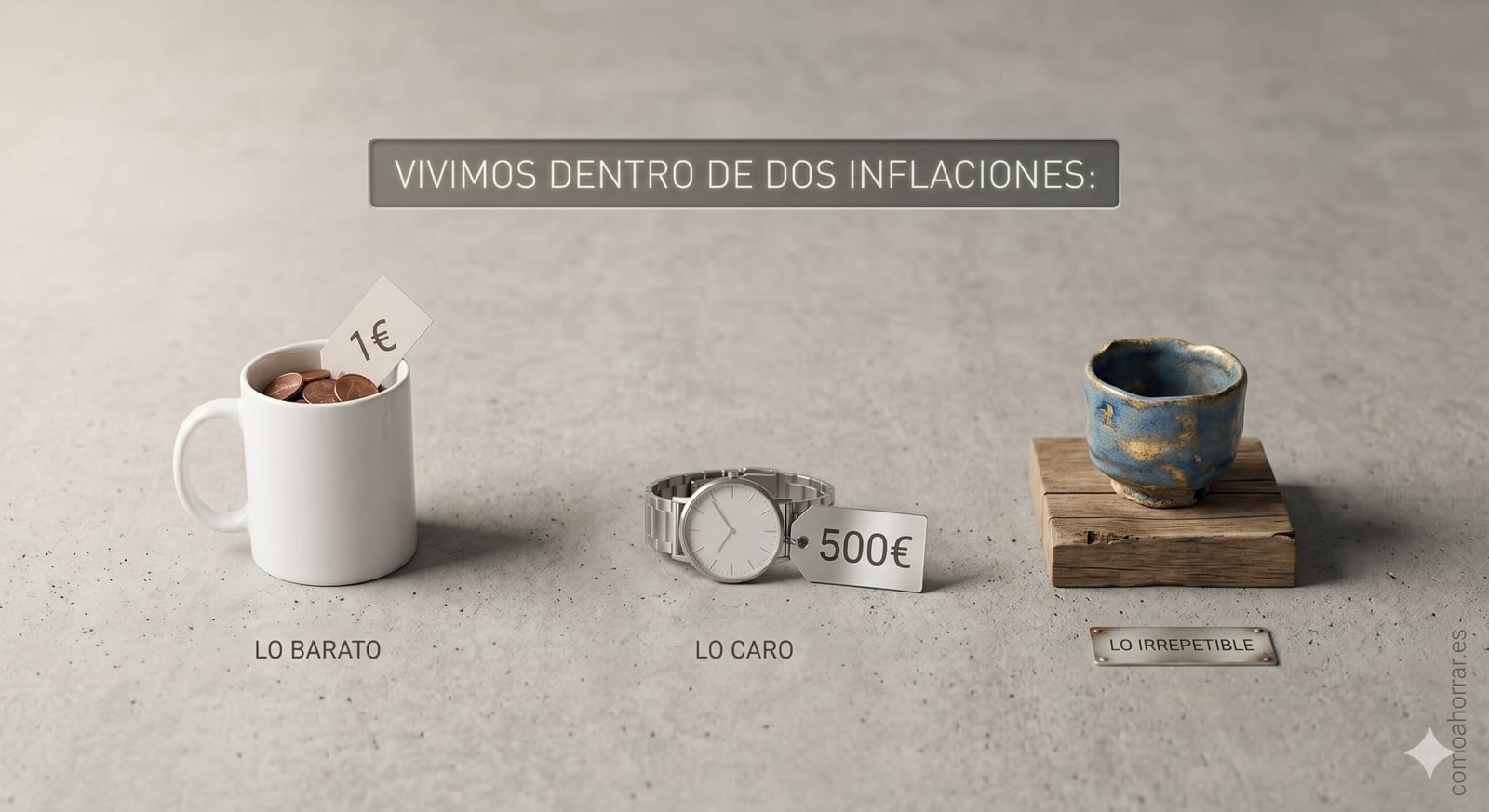
Yesterday at lunch we ended up talking about something that seems ordinary, but explains pretty well why so many people feel that life has become expensive in a strange way. Someone was complaining about how much it costs to go to a concert these days. Another person replied that back in 1995 we weren’t all going to concerts, festivals, restaurants, or international getaways every weekend either. And they had a point. But the conversation got interesting when we stopped debating whether life was better in the past and started looking at which things have become cheaper and which have skyrocketed.
Because inflation isn’t a single thing. We live inside two different inflations. One affects the goods that technology, globalization, logistics, and scale have managed to make dramatically cheaper. The other affects everything that still depends on human time, physical presence, scarce land, irreplaceable talent, or limited experiences. In the first economy, your salary buys far more than it did thirty years ago. In the second, it buys quite a bit less.
What Could Be Manufactured Better Became Cheap
There’s a part of our daily life that has become so cheap that we’ve almost stopped seeing it as wealth. A large-format television, once a luxury reserved for a few households, today costs a fraction of what it once did in real terms. A mid-range smartphone today has more computing power, camera quality, screen, and connectivity than professional equipment from not so long ago. Basic clothing, with all the labor and environmental problems that may lie behind certain production chains, costs very little compared to the salaries of three decades ago.
The same has happened with communications. Anyone who lived through the nineties remembers calling carefully, watching the clock, paying for long-distance calls, using phone cards, or connecting to the Internet with the feeling that every minute counted. Today we take for granted that we can talk, send videos, make video calls, listen to music, work remotely, and browse almost without limit from a device that fits in our pocket.
Travel also changed scale. Flying to London, Rome, or Paris used to be a major decision for many families. Today it can cost less than dinner for two if you book in advance and accept the rules of low-cost airlines. It isn’t always comfortable, it isn’t always as cheap as it seems at first, but the leap is real.
This didn’t happen by chance. Manufacturing productivity, international logistics, software, automation, and global competition have changed the cost structure. Where there were once slow, expensive, local processes, there are now global chains capable of producing millions of units with an efficiency that was hard to imagine thirty years ago.
A basic t-shirt illustrates it well. In 1995 it might have cost around 1,800 pesetas, roughly 11 euros. Today you can find one for between 3 and 12 euros. Not because cotton has stopped costing money, but because the entire chain, from design to container shipping, has been compressed. Productivity per worker has grown enormously.
What Requires Human Time Became Expensive
The contrast appears when we look at a haircut. In 1995 it might have cost around 600 pesetas, about 3 euros, at least in my hometown of Herencia (Ciudad Real). Today it’s easy to pay no less than 21 or 22 euros. And yet the service is basically the same: one person, a pair of scissors, a shop, half an hour, and your head held still.
You can’t produce a haircut in a factory in Southeast Asia and ship it over by boat. You can’t speed it up too much without ruining the result. You can’t serve ten people at once without turning the service into something else entirely. That’s the key.
William Baumol explained this phenomenon in the 1960s with what he called the cost disease. There are sectors where productivity improves a great deal, such as industry, technology, or transport. And there are others where it can barely improve without destroying the essence of the service: in-person education, care work, hospitality, hairdressing, live music, theater, healthcare, private tutoring, or personal services.
A string quartet today needs almost the same amount of time and the same musicians to play a piece as it did two centuries ago. A private tutor can’t give a truly personalized class to a hundred students at once. A waiter can’t multiply their productivity indefinitely without the restaurant losing quality. A caregiver for the elderly can’t attend to many people with the same attention they give to a few.
But all of those sectors compete for workers within the same economy. If general wages rise, they too have to pay more, even though their productivity doesn’t grow at the same pace. That’s why their prices tend to rise more.
Here lies an important part of today’s discontent. Many material things are cheaper than ever, but many in-person experiences and services are more expensive than ever. We can have an enormous television at home for very little money, but going to the movies with the family has become a small budgetary decision. We can buy cheap clothing, but eating out with any frequency weighs much more heavily on the bill. We can talk for free over video call with half the world, but a private lesson, a consultation, a children’s activity, or an hour of padel are paid at the price of human time.
Experience Became Status
On top of this economic difference there’s another layer: status. Demonstrating a certain standing used to mean having a car, a television, a stereo system, or branded clothing. Today many of those goods have been democratized. Almost everyone has a big screen, a capable phone, access to platforms, and enough clothes.
Status has shifted toward what is lived. Having been at that concert. Having gone to that restaurant. Having traveled to that destination. Having scored tickets to that match. Having taken the kids to that theme park. Having taken part in that experience others see on social media.
Pine and Gilmore called this the experience economy in the late nineties. Today we see it clearly. Experience has two characteristics that push the price up: it is limited and it can be shown off. An international artist can only perform a few nights in a city. A stadium has a finite number of seats. A trendy restaurant can’t double its tables without completely changing the experience. A theme park has a maximum capacity. A desirable city has limited land.
When demand grows and supply can’t grow the same way, the price goes up. And if on top of that you add social media, resale, dynamic pricing, and a culture increasingly built on recounting what you’ve experienced, the effect is amplified.
That’s why we’re not surprised to see concert tickets at 150, 200, or 500 euros. Or football matches that were once popular entertainment and now start to look like a premium product that not everyone can access. Or restaurants where booking is part of the value. Or theme parks that no longer sell just a ticket, but priority access, packages, add-on experiences, and hotels.
It’s not just inflation. It’s scarcity organized around desire.
Housing Is the Most Painful Case
Housing deserves a section of its own, because it doesn’t fit exactly into the experience category, but it shares something fundamental: it can’t be freely manufactured where it’s needed.
A television is produced in a factory and distributed all over the world. A home in Madrid, Barcelona, Málaga, Valencia, or any high-pressure city depends on land, permits, financing, regulations, construction, location, transport, nearby employment, and investment expectations. You can’t manufacture thousands of apartments on another continent and ship them over in containers.
That’s why housing has become the great generational divide. Those who bought decades ago accessed a relatively cheaper asset and then watched it appreciate. Those trying to buy today face high prices from the start, salaries that haven’t grown at the same pace, and rents that make it hard to save for a down payment.
This is perhaps the harshest expression of the two inflations. Technology gives you more for less. Housing asks you for more in exchange for the same, or even for less. You can carry in your pocket a phone that would have seemed like science fiction in 1995, but it costs you far more to live near your job or start a family without depending on outside help.
Not Everything Was Better Before, but Some Things Were Closer
It’s worth avoiding easy nostalgia. In 1995 there were fewer options, less connectivity, less digital convenience, less access to information, less ease of travel, and fewer tools to create, learn, or start a business. Many things were worse. Many were slower. Some simply didn’t exist.
But it’s also true that certain basic goals were closer for part of the middle class. Buying a home, starting a family, paying for the kids’ activities, or accessing a bit of local leisure didn’t seem so far out of reach of a salary. Not because everything was cheap, but because the price structure was different.
Today abundance is concentrated in what’s replicable. We have infinite music, infinite video, infinite information, cheap clothing, cheap screens, cheap communication, and more accessible flights. Scarcity is concentrated in what’s in-person, localized, human, and symbolic. Time, land, care, attention, talent, exclusivity, and experiences.
That’s where the paradox of our time is born: we live surrounded by extraordinary technology, yet many people feel that ordinary life has become more expensive. And they’re not necessarily wrong. What’s happening is that “ordinary life” is no longer made up only of cheap industrial goods. It also includes housing, family leisure, care, education, health, sport, dining out, and social belonging. Precisely the categories where productivity hasn’t grown the same way or where supply is limited.
We don’t simply live in an expensive economy. We live in a split economy. Where there’s scale, software, and global competition, we are richer than ever. Where there’s human presence, scarce land, and desired experiences, we are poorer than we expected to be.
That’s why someone can rightly say we’ve never had so much for so little. And someone else can answer, also rightly, that going out for an afternoon with their family has become a luxury. Both are looking at real prices. They’re just looking at different inflations.
Frequently Asked Questions
What does it mean that we live inside two inflations?
It means that some goods, such as technology, basic clothing, or telecommunications, have become cheaper in relative terms, while many in-person services, leisure, housing, and experiences have become much more expensive than salaries.
What is Baumol’s cost disease?
It’s an economic theory that explains why certain services rise in price even though their productivity doesn’t improve much. If they require human time that’s hard to automate, their costs grow alongside general wages.
Why are concerts, restaurants, and matches increasingly expensive?
Because they are experiences with limited supply and growing demand. A stadium has a finite number of seats, an artist can only perform on certain days, and a restaurant can’t double its tables without changing its proposition.
Why does technology seem so cheap compared to other expenses?
Because manufacturing, software, automation, and global logistics have multiplied productivity. That makes it possible to sell much better products for less money in relative terms than thirty years ago.