Before the billions, Elon Musk learned what Edison, Ford and Jobs did: the idea isn't enough
The least interesting thing about Elon Musk is debating whether you like him or not. That has already become almost a sport. For some, he is the great industrial entrepreneur of our era. For others, he is an excessive, contradictory and dangerous figure when he mixes economic power, technology, politics and public communication.
I am more interested in another question: what does Musk have in common with some of the great inventors and entrepreneurs in history? And, above all, what sets his case apart from those of Edison, Ford, Jobs, Bezos or Rockefeller?
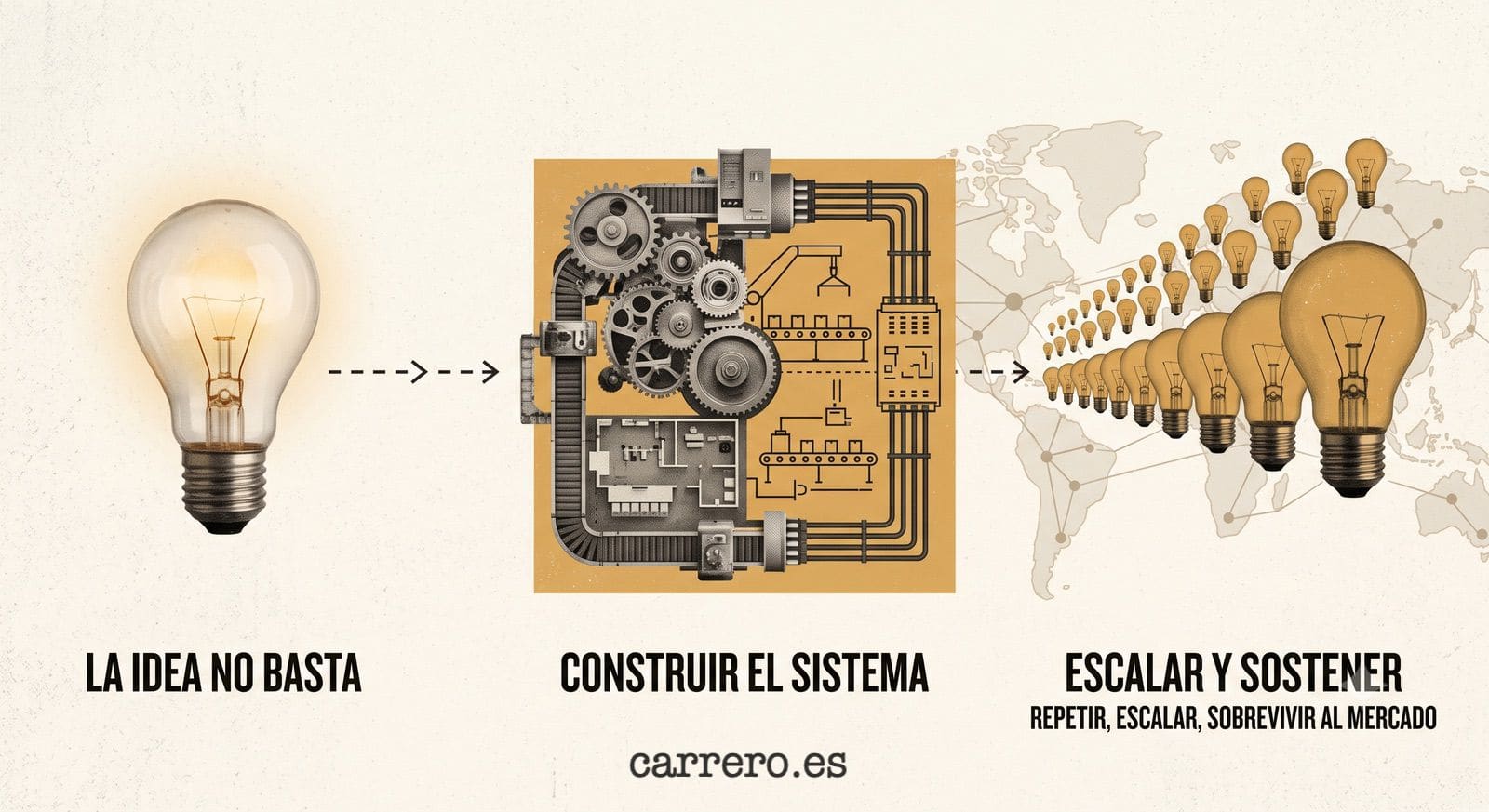
Because if you look at his trajectory with some distance, the comparison is not so far-fetched. Not because they are all the same, nor because Musk has to be turned into an icon to worship, but because in all of them a recurring pattern appears: great innovation rarely consists only of having a good idea. It consists of turning that idea into a system that works, repeats, scales and survives the market.
That is far less romantic than imagining an isolated genius changing the world from a notebook. But it is probably more real.
Elon Musk has not become relevant just by founding companies. He has become relevant because he has pushed physical, expensive and difficult sectors: cars, batteries, rockets, satellites, networks, artificial intelligence, energy. In other words, sectors where mistakes cannot be fixed with a mere software update. If a car fails, it has to be repaired. If a factory jams, cash burns. If a rocket explodes, there usually aren’t many more chances with the same equipment and configuration.
That is why the image of Musk sleeping at the factory during the Model 3 “production hell” has become so powerful. Not because sleeping on the floor is a leadership recipe. In fact, it shouldn’t be. But because it sums up an idea that is often forgotten in technology: reality is decided on the factory floor, not in the presentation.
The great builders didn’t just invent products, they invented systems
Thomas Edison wasn’t important just for his patents. He was important because he understood that invention could be organized as a process. His Menlo Park laboratory was not a room for inspiration, but a factory of tests, prototypes, errors and improvements. The light bulb, for example, was not just a light bulb. It needed electrical generation, distribution, switches, meters, installation and a way to bring electricity to homes and businesses.
Henry Ford was not just “the car man” either. The automobile already existed. His great change was another one: manufacturing cars far more efficiently, reducing costs and turning a luxury product into something more accessible to millions of people. The 1913 assembly line was not an industrial anecdote. It was a new way of organizing work, time, parts, suppliers and scale.
Steve Jobs did not invent the personal computer, nor the MP3 player, nor the smartphone as an isolated concept. His talent lay in integrating technology, design, software, distribution, brand and user experience until the product seemed inevitable. The iPhone didn’t win just for being a pretty phone. It won because Apple connected hardware, operating system, app store, carriers, developers and a new way of relating to the device. In fact, today many of us carry his technology in our pockets with that very same concept.
Jeff Bezos started by selling books online, but Amazon didn’t become Amazon by selling books. It did so by building a logistics, technological and commercial machine capable of promising convenience at scale. Behind the buy button there were warehouses, data, cloud infrastructure, negotiation with suppliers, subscriptions, delivery and an obsession with cutting times.
Musk belongs to that tradition of system builders. Tesla is not just an electric car. It is a mix of batteries, software and technology, manufacturing, charging, brand, data, vertical integration and engineering culture. SpaceX is not just a rocket company. It is manufacturing, engines, reusability, recurring launches, public contracts, satellites, data centers for xAI and artificial intelligence, future data centers in space and a global network like Starlink.
The idea matters. But the system decides.
| Figure | What it seemed to sell | What it really built | Useful lesson |
|---|---|---|---|
| Thomas Edison | Electrical inventions | Laboratories, patents, networks and systems of use | Invention needs infrastructure |
| Henry Ford | Cars | Mass production and industrial efficiency | Scale can change the market |
| Steve Jobs | Devices | Integrated experience of hardware, software and brand | The product is also perception |
| Jeff Bezos | Online books | Logistics, marketplace and cloud | Convenience is manufactured behind the scenes |
| Elon Musk | Cars and rockets | Industrial platforms of energy, mobility, space and data | Physical technology demands extreme execution |
Musk didn’t start from scratch, but he did choose real risk
One of the common mistakes when telling these stories is exaggerating the initial poverty or turning the journey into a fable of perfect self-improvement. Musk did not arrive at Tesla and SpaceX with nothing. He came from Zip2 and PayPal, with capital, experience, contacts and an ability to attract talent that the average entrepreneur does not have.
That doesn’t take away from his merit. It makes it more realistic.
Zip2 was sold to Compaq in 1999 for 307 million dollars. X.com ended up being part of PayPal, and eBay bought PayPal in 2002 for 1.5 billion. Musk came out of that with a fortune that would be enormous for anyone. The reasonable decision would have been to diversify, invest and live very well.
But he did something else. He bet very large amounts of his own wealth on sectors where failure was likely. SpaceX seemed like madness: building private rockets when space was dominated by governments and traditional contractors. Tesla also seemed improbable: manufacturing electric cars when the automotive industry was capital-intensive, full of giants and barely believed in that market.
That point seems important to me. We often confuse “having vision” with “saying something ambitious.” But vision only carries weight when someone commits resources, reputation and time in a direction that can go wrong.
In 2008 it came very close to going wrong.
SpaceX had racked up three failures with the Falcon 1. Tesla had cash problems, delays and a global financial crisis on top of it. Musk has recounted several times that he had to split his last resources between the two companies. If the fourth Falcon 1 launch had failed, we would probably be telling a different story today. A shorter one, harder and less mythical. Or maybe not, because he might have been able to raise more resources to keep trying.
But the Falcon 1 reached orbit in September 2008. Shortly after, NASA awarded SpaceX a 1.6 billion dollar contract for cargo missions to the International Space Station. Tesla also secured critical funding. They survived by a hair.
And here a difference appears between great industrial entrepreneurs and mere sellers of promises: at some point, reality has to validate the story.
| Moment | Risk | What was at stake | Outcome |
|---|---|---|---|
| Zip2 | Loss of control to investors | First company and founder learning | Sale to Compaq |
| PayPal | Leadership conflicts and replacement as CEO | Control of the initial vision | Major financial exit after the sale to eBay |
| SpaceX 2008 | Three failed launches | Survival of the company | Falcon 1 reaches orbit |
| Tesla 2008 | Lack of cash and financial crisis | Continuity of the electric project | Critical funding and survival |
| Model 3 | Scaling mass production | Turning Tesla into a real manufacturer | Target of 5,000 Model 3 per week in 2018 |
The factory as the final exam
In software you can fall into a trap: thinking that everything is fixed by iterating fast. That is partly true. Software lets you test, correct, deploy and measure at a speed that traditional industry did not have. But when software touches atoms, the rules change.
A car does not scale like an app. A rocket does not deploy like a website. A battery does not forgive a bad materials decision. A satellite does not come back to the workshop once it is in orbit.
That is where Musk resembles Ford more than many digital founders. His obsession with the factory is not decorative. Tesla learned, sometimes the hard way, that automating too soon can create more problems than it solves. The Model 3 ramp made that lesson very clear: manufacturing at scale is not about assembling more units, but about building a system that does not collapse when volume rises.
The expression “production hell” became famous because it sounded dramatic, but it described something real. Tesla had to prove that it was not a company of expensive prototypes, but a manufacturer capable of producing thousands of cars per week. Musk slept at the factory, dug into the bottlenecks and turned that crisis into part of his narrative.
Here it is worth separating two things.
The first: being close to the problem is a virtue. There are executives who manage from dashboards, meetings and intermediate layers until they lose touch with reality. In difficult industries, that can be lethal. The factory, the customer, the support desk, the data center or the production line tell truths that don’t always show up in a committee.
The second: romanticizing exhaustion is dangerous. A founder sleeping at the factory may be a sign of commitment, but it can also indicate that the system depends too much on one person. A mature company should not always need a heroic act to function.
That tension defines much of Musk’s leadership. He is able to push limits that others wouldn’t dare to touch. But that same style can also generate burnout, turnover, fear, hasty decisions and a culture too dependent on the founder.
The uncomfortable question is: how much of that sacrifice was necessary and how much was a symptom of a system pushed to the limit? And is Musk preparing his companies to survive without his leadership?
Comparing Musk to Edison, Ford, Jobs or Bezos helps, but it also misleads
Historical comparisons are useful if we don’t use them to manufacture saints. Edison was brilliant, but also aggressive in defending interests and patents. Ford revolutionized manufacturing, but held very questionable personal and political positions. Jobs created extraordinary products, but his management style could be brutal. Bezos built one of the most influential companies in the world, although Amazon has been criticized for years over labor pressure and its market power.
The same happens with Musk. His achievements are enormous, but they don’t oblige you to buy the whole persona. You can recognize that SpaceX changed the space sector and, at the same time, question his way of communicating. You can accept that Tesla accelerated the electric car and, at the same time, debate its timelines, its culture or some corporate governance decisions. You can admire industrial ambition without turning it into intellectual obedience.
In fact, that may be a healthier way to study these figures: not asking ourselves whether they are good or bad, but what mechanisms they used to change industries and what costs they left along the way.
| Entrepreneur | Great virtue | Great shadow | Open question |
|---|---|---|---|
| Edison | Turning invention into an organized process | Aggressive competition and patent control | Where does defending an idea end and blocking others begin? |
| Ford | Democratizing the car through scale | Cultural rigidity and highly questionable personal positions | Can industrial innovation be separated from the character of the person leading it? |
| Jobs | Integrating product, design and desire | Very harsh personal management | How much internal suffering do great products justify? |
| Bezos | Building a global commercial infrastructure | Market power and operational pressure | When does efficiency begin to concentrate too much power? |
| Musk | Bringing advanced technology into the physical world | Volatility, personalistic excess and extreme culture | Can the intensity that creates breakthroughs also destroy teams? |
This table does not try to equate them. It only shows a constant: many people who change industries mix genius, obsession, conflict and human cost. History tends to keep the products. Companies also live the scars.
Money as an imperfect marker
In 2026, after the SpaceX IPO, various estimates temporarily placed Elon Musk above one trillion dollars in wealth. The figure is almost absurd, so large that it is hard to grasp. But it is also misleading.
Most of that wealth is not money in a checking account. It is market value of stakes in companies, especially SpaceX and Tesla. It can rise or fall violently. In fact, after reaching that level, several estimates again cut his wealth due to the drop in share prices.
This also deserves a reading. In our era, extreme wealth doesn’t only measure present profits. It measures expectations. Musk is worth what the market believes his companies could become: a space platform, a satellite network, a defense player, more or fewer data centers for AI, an AI company, a car manufacturer, an energy provider, perhaps something more.
It is a valuation of the future, not just the present.
And that opens another question: to what extent do we reward real results and to what extent do we reward convincing narratives about what could happen?
Musk masters that mix like few others. He builds real things, but he also masters the story. In that he resembles Jobs, though with a different style. Jobs turned a presentation into product theater. Musk turns an industrial plan into a public epic, sometimes brilliant and sometimes chaotic.
What a normal entrepreneur can learn from all this
Most of us are not going to found SpaceX, nor Tesla, nor Amazon, nor Apple. And maybe we shouldn’t try to literally copy those who did. The typical mistake of business literature is turning extreme cases into general recipes.
Not everyone can or should manage like Musk. Not all companies need to live in emergency mode. Not all teams respond well to constant pressure. And not all problems are solved by working more hours.
But there are useful lessons.
The first: be close to where value is created. In a tech company that may be the code, support, infrastructure, the customer, operations or sales. In an industrial one it will be the factory. In a services company it may be the team that talks to the customer every day. Great problems are rarely understood only from the top.
The second: distinguish between idea and system. A good idea attracts attention. A good system generates repeated results. The difference between the two is enormous.
The third: assume that scale changes the nature of the problem. Selling ten units does not teach the same as selling ten thousand. Serving one customer does not teach the same as serving a thousand. Launching a prototype does not teach the same as sustaining an operation for years.
The fourth: don’t confuse sacrifice with strategy. Working hard may be necessary at certain moments, but it does not replace designing processes, hiring well, delegating, measuring and building a culture that does not depend on a single person.
And the fifth: keep your own judgment in the face of myths. Musk, like Edison, Ford, Jobs or Bezos, offers valuable lessons. But also warnings.
Some questions this story leaves me with
I am more interested in ending with questions than with a closed conclusion, because I believe these profiles do not allow for a simple reading.
To what extent does a company need an obsessive personality to break very entrenched industries?
Is it possible to build such ambitious companies without extreme work cultures?
Where is the line between demanding leadership and unnecessary burnout?
Does the market reward too much those who know how to tell the future before fully proving it?
Could Europe produce industrial entrepreneurs of this type, or does our cultural, financial and regulatory framework push them out before their time?
Do we want more founders like this, or do we want more balanced companies, even if they advance more slowly?
My impression is that Elon Musk belongs to that rare category of entrepreneurs who not only create products, but force entire sectors to move. That does not make him perfect. Nor does it make him imitable. It makes him relevant.
Before the billions, before the headlines and before the eternal debate over whether he is a genius or a villain, Musk learned a lesson that other great builders had already understood: an idea only changes the world when someone manages to manufacture it, repeat it and sustain it long enough.
The epic helps to tell the story. The factory decides whether it was true.