AI Isn't Destroying Jobs: It's Changing the Price of Work
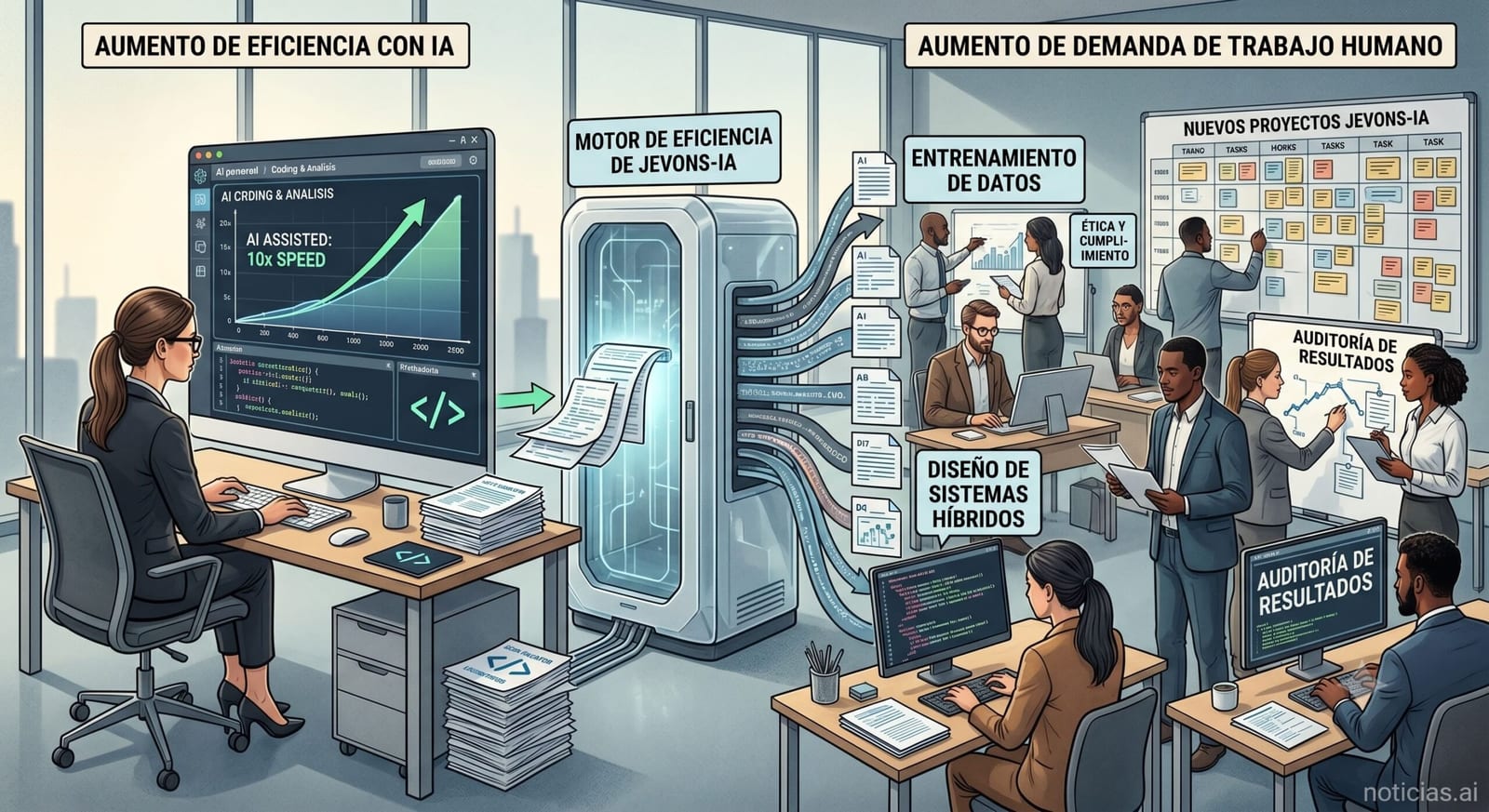
Over the past few months I’ve read far too many times that artificial intelligence is going to destroy sophisticated jobs. Lawyers, programmers, analysts, designers, copywriters, consultants, finance professionals, system administrators… all in danger. All on the same list of future casualties, as if a technology could wipe out, in one stroke, decades of corporate organization, client relationships, professional judgment and accumulated knowledge.
I’m not saying artificial intelligence won’t destroy tasks. It already is. Nor am I saying there are no jobs at risk. That would be naive. What I find hard to accept is the simplistic idea that more AI automatically means fewer jobs. The history of technology tends to be a good deal more uncomfortable than that headline.
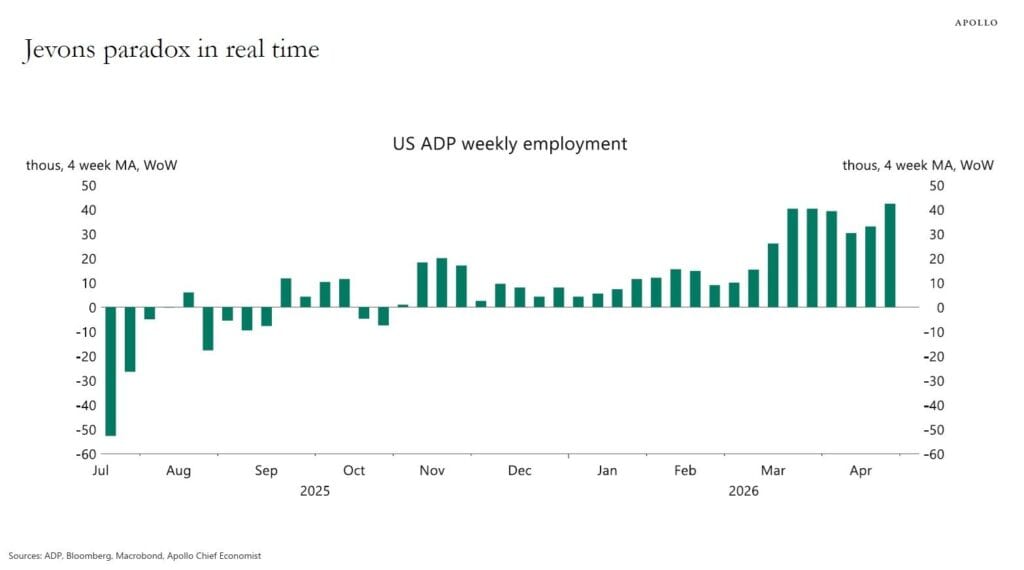
The image Apollo shared with weekly private-employment data from ADP strikes me as a good excuse to talk about this. The chart was titled “Jevons paradox in real time” and showed positive job creation in the United States, not an abrupt drop. It doesn’t prove that AI is creating jobs on its own, but it does dismantle part of the most alarmist narrative: if mass job destruction by AI were already clearly underway, we should be able to see it more clearly in the aggregate data.
It seems to me we’re looking at the problem the wrong way. AI doesn’t just replace work. It also lowers the cost of doing certain things. And when something becomes cheaper, faster and more accessible, it often isn’t used less. It gets used much more.
The Jevons paradox applied to knowledge work
William Stanley Jevons explained in 1865 something that remains very useful for understanding technology. When steam engines became more efficient and needed less coal per unit of work, total coal consumption didn’t fall. It rose. Efficiency made energy cheaper to use, enabled new industries and multiplied total demand.
That is the Jevons paradox: an efficiency improvement can increase the total consumption of the very resource it seemed it would save.
With AI, something similar may be happening, but applied to knowledge work. If drafting a report costs less, more reports will be written. If building a feature costs less, more products will be attempted. If analyzing a contract is faster, more contracts will be reviewed. If creating campaigns, documentation, support, financial analysis or code becomes cheaper, projects appear that previously didn’t pay off.
Artificial intelligence lowers the cost of producing knowledge. And when that cost drops, the market doesn’t always respond by reducing employment. It can respond by expanding the number of things it wants to do.
This already happened with personal computers. In the late ’80s and early ’90s, people also said the PC would do away with much of office work. And yes, it eliminated tasks. Many manual processes disappeared, profiles changed and repetitive jobs were automated. But entire categories were also born: technical support, systems administration, enterprise software, digital design, databases, e-commerce, online marketing, cybersecurity, cloud, analytics, ERP, CRM and a long list of others.
The office didn’t disappear. It filled up with screens.
With AI, something similar may happen. Knowledge work won’t disappear, but it will fill up with agents, models, copilots, automations and new productivity expectations.
Data that invites us to ease the alarmism
Employment data shouldn’t be read as an absolute truth about artificial intelligence. The labor market depends on interest rates, consumption, investment, demographics, wages, geopolitics and many other factors. But it does help set limits on the narrative.
In April 2026, ADP estimated that the U.S. private sector added 109,000 jobs and that annual pay rose 4.4%. The BLS, the U.S. Bureau of Labor Statistics, reported that nonfarm employment increased by 115,000 jobs that same month and that the unemployment rate held at 4.3%. ADP also noted that, for the four weeks ending May 9, 2026, private employers added an average of 35,750 jobs per week.
These aren’t euphoric figures, but they aren’t collapse figures either.
| Indicator | Recent figure | Reasonable reading |
|---|---|---|
| ADP, private employment in April 2026 | +109,000 jobs | Shows no aggregate destruction of employment |
| ADP, annual pay in April 2026 | +4.4% year over year | Wage pressure still exists in part of the market |
| ADP NER Pulse, 4 weeks to 05/09/2026 | +35,750 jobs per week on average | Hiring is slowing, but still positive |
| BLS, nonfarm employment in April 2026 | +115,000 jobs | The labor market is still creating jobs |
| BLS, unemployment in April 2026 | 4.3% | No sign of a general labor-market break |
| BLS, 2024-2034 projection | +5.2 million jobs in the U.S. | Slower growth, but not the disappearance of jobs |
The interesting thing isn’t to deny the risks. The interesting thing is to separate three things that get mixed up far too often: task substitution, corporate restructuring, and net job destruction.
One company may lay people off using AI as the rationale. Another may be correcting the over-hiring of 2021 and 2022. Another may be outsourcing. Another may be automating administrative tasks. Another may be hiring data, automation, security or AI-integration profiles. Lumping all of that into the same sentence, “AI destroys jobs,” is convenient but not very precise.
We also have to look at where demand is shifting. The BLS projects that office and administrative support jobs will decline over the 2024-2034 decade, although they will still generate around 2 million annual openings from replacing workers who leave those positions. At the same time, computing and technology occupations had a median annual wage of $105,990 in May 2024, compared with $49,500 for all occupations combined. And within that family, profiles such as systems analysts or computer researchers are still projecting above-average growth.
| Job area | BLS figure | What it tells us |
|---|---|---|
| Office and administrative support | Employment projected to decline in 2024-2034 | Automation does pressure repetitive tasks |
| Office and administrative support | About 2 million annual openings | Even in declining areas there will still be replacement |
| Computing and technology | $105,990 median annual wage in 2024 | The market rewards technical profiles |
| All occupations | $49,500 median annual wage in 2024 | The tech premium remains very high |
| Systems analysts | +9% projected in 2024-2034 | More growth than average |
| Computer researchers | +20% projected in 2024-2034 | Demand for advanced profiles keeps growing |
The real picture isn’t “everyone loses” or “everyone wins.” It’s a redistribution. And, as almost always, whoever adapts first captures more value.
Examples where efficiency increased demand
The Jevons paradox isn’t a historical curiosity. We see it over and over again.
When the cloud made launching infrastructure cheaper, it didn’t reduce the use of servers. It multiplied it. Before, a company had to buy machines, provision space, set up networks, forecast capacity and amortize hardware. With the cloud, deploying an application became easier. The result: more applications, more environments, more testing, more data, more infrastructure consumption.
When digital cameras and phones made taking photos almost free, we didn’t take fewer photos. We took millions more.
When the cost of publishing fell with WordPress, social media and newsletters, fewer articles weren’t published. An enormous amount of content was published.
When creating an online store became easier with Shopify, WooCommerce or Prestashop, commerce didn’t disappear. Thousands of small digital businesses appeared that previously couldn’t have taken on the technical cost.
With artificial intelligence, something similar happens. If a small business can prepare a sales proposal in an hour instead of a whole afternoon, it may not cut staff. It may prepare five more proposals a month. If a developer can build a proof of concept in two days instead of two weeks, the company may not lay off the team. It may test ten ideas that never made it past the PowerPoint.
| Technology | What it made cheaper | What happened next |
|---|---|---|
| PCs in offices | Documents, spreadsheets, internal management | More information, more software, more digital processes |
| Cloud computing | Servers and deployments | More applications, more environments, more infrastructure consumption |
| Digital cameras and phones | Photography | Explosion in the volume of images |
| WordPress and social media | Publishing | More media, blogs, newsletters and content |
| E-commerce SaaS | Online stores | More businesses selling on the Internet |
| Generative AI | Text, code, analysis, automation | More possible tasks, more projects and more productivity pressure |
The key is this: when the unit of work drops in price, the volume can go up.
The real risk: junior jobs and the productivity gap
That said, I don’t want to fall into naive optimism. There are clear risks.
The first lies in junior profiles. Many entry-level tasks consist of producing drafts, reviewing documentation, preparing reports, cleaning data, writing basic text, running tests, answering simple tickets or writing not-very-complex code. That’s exactly where AI helps a lot.
If companies eliminate too many entry-level positions, they can break the talent pipeline. Today it seems efficient to replace part of the junior work with AI. Tomorrow there may be a shortage of people with mid-level experience because no one learned by doing that basic work.
The second risk lies in the gap between professionals. A lawyer with AI doesn’t automatically replace all lawyers. But a lawyer who uses AI well can work much faster than one who doesn’t. The same happens with programmers, consultants, finance professionals, journalists, systems engineers or marketing managers.
The third lies in corporate concentration. Large companies can pay for better models, more context, more agents, more integration with internal data and more automation. Small businesses may be left with more limited versions if they lack strategy, budget or technical knowledge. This could open up a very serious productivity gap.
The fourth lies in energy and infrastructure. If the Jevons paradox holds for AI, we won’t consume less compute by making models more efficient. We’ll consume more. More agents, more inference, more data centers, more memory, more networks, more electricity. Efficiency can make intelligence cheaper and, precisely for that reason, send its use soaring.
My personal take
My sense is that AI isn’t going to destroy work in a linear way. It’s going to change its price.
Some tasks will be worth less because they’ll be easier to automate. Others will be worth more because they’ll coordinate systems, people, data and decisions. Value will shift from “doing the task” toward “knowing which task is worth doing, with what data, under what criteria and with what responsibility.”
This strikes me as important for anyone running a company or a team. The question shouldn’t only be “how many people can I save with AI?” That’s a poor question. The good question is: “what can I do now that wasn’t viable before?”
Can I serve my customers better? Can I document processes we never documented? Can I catch errors earlier? Can I run more experiments? Can I sell in more markets? Can I do better financial tracking? Can I improve security? Can I give tools to people who were previously blocked by a lack of time?
That’s where the interesting part lies.
AI doesn’t eliminate the need for judgment. Quite the opposite. When producing becomes cheap, deciding what to produce becomes more important. When generating text is easy, having something to say matters more. When writing code speeds up, understanding the problem carries more weight. When an agent can carry out tasks, defining limits, permissions and objectives becomes essential.
The Jevons paradox applied to AI doesn’t mean everything will turn out fine. It means efficiency doesn’t guarantee a reduction in human work. It can produce more demand, more pressure, more competition and more activity. It can also leave behind those who don’t adapt.
I don’t yet see clear evidence that AI is destroying jobs on a massive scale in the aggregate data. I do see something else: it’s changing the productivity frontier. And when that frontier moves, every company, every professional and every country has to decide whether to stand by watching or learn to work with the new tool.
PCs didn’t put an end to the office. They transformed it.
AI probably won’t put an end to knowledge work. It will make it more demanding, more measured and more competitive.
Frequently asked questions
What is the Jevons paradox applied to AI?
It’s the idea that, if AI makes producing knowledge, code, analysis or content cheaper and more efficient, total demand for those tasks may increase rather than fall.
Will AI destroy jobs?
It will destroy tasks and some specific positions, especially the most repetitive ones. But the aggregate data doesn’t yet show massive job destruction clearly attributable to AI.
Which profiles may be under the most pressure?
Junior profiles and entry-level tasks based on repetitive work, basic review, simple writing, initial support or low-complexity code may be the most exposed.
What should companies and professionals do?
Measure where AI improves real productivity, train teams, redesign processes and use it to expand capacity, not just to cut costs in the short term.
Sources:
- Apollo, “Zero Evidence of AI-Related Job Losses”.
- Apollo, “The Jevons Employment Effect From AI”.
- ADP Research, National Employment Report and NER Pulse.
- U.S. Bureau of Labor Statistics, Employment Situation, April 2026.
- U.S. Bureau of Labor Statistics, Occupational Outlook Handbook.
- Yale Energy History, William Stanley Jevons, The Coal Question.
- OECD, work on artificial intelligence and employment.